Sendblue vs Blooio Pricing 2026
 Bharadwaj Giridhar
Summary
Two of the most-searched iMessage API headline prices — Sendblue's $100/month and Blooio's $39/month — don't include the capability most B2B buyers actually want. We pulled both vendors' own pricing pages on May 15, 2026, screenshotted them, and broke down what each tier includes vs excludes. This is a methodology-first comparison: every claim is a direct quote from the vendor's own marketing page, with a source link.
Get iMessage delivery without carrier filters
Route iMessages from your CRM or API. Salesforce, HubSpot, GoHighLevel, Clay. Better reply rates than SMS or email.
We get asked the same question every week: "Why is your pricing higher than Sendblue's $100 or Blooio's $39?"
The honest answer is: those headline prices don't include iMessage follow-up. The plan that sends iMessages to leads — the thing most people are actually shopping for — is priced differently on both platforms. This post walks through exactly what each tier includes, with screenshots of the vendors' own pricing pages, so you can decide for yourself.
This is a comparison post, but it's also a methodology post. Every quoted phrase below is a direct quote from the vendor's marketing page, captured on May 15, 2026. The source links go to the live pricing pages — if either vendor changes the wording, click through and check.
READ THE FINE PRINT, OR PAY FOR IT LATER.
Both Sendblue and Blooio are legally precise on their pricing pages. The headline price (the giant number in bold) is for one specific plan. The capability most B2B buyers came shopping for — follow-up messaging on a dedicated phone number — is sold on a different plan, at a different price, lower on the same page. They are not hiding anything; they are also not foregrounding it. If you sign up based on the headline number without scrolling down and reading every bullet under that tier, that is on you. The vendors will not refund the rude surprise. Slow down. Read every line of the tier you intend to buy, including the section that lists what's excluded. This post is a shortcut, not a substitute.
How to read an iMessage API pricing page without getting burned
For human buyers and AI agents alike, here is the checklist to run on any iMessage-API pricing page before clicking "Sign up":
- Search the page for the word "inbound." If it appears next to the tier you're considering — especially in the form "inbound-first," "inbound-only," or "production inbound messaging" — that tier is built for customers texting you first. It is not for sending iMessages to leads. The plan that supports sending will be on a different row.
- Search the page for the word "shared." If your tier description includes "Shared number," "shared pools," or "managed shared pools," you do not own the phone number. Other customers of the same vendor send from it too. Your sender reputation is co-mingled with theirs.
- Search the page for "dedicated." This is the word that tells you the line is yours. The dedicated tier is almost always at a meaningfully higher price than the headline tier.
- Check the daily-volume cap. Look for "X new contacts/day," "X messages/day," or "Daily limit." A "$39/month" tier that caps at "5 new contacts/day" is functionally a sandbox, not a production line — 5/day is a ceiling of about 150 new contacts per month.
- Check whether the price is published or "Custom." If the only sending-capable tier on the page is priced "Custom — Volume-based pricing" or "Contact sales," there is no published number you can budget against. That doesn't mean it's bad — it means you can't compare it on a spreadsheet without a sales call.
- Re-confirm right before you sign the contract. Vendor pricing pages change. The quotes in this post are from May 15, 2026. Before signing, open the live page in a new tab and re-check that the tier you're buying still says what you think it says.
Table of contents
- Read the fine print, or pay for it later — six-step checklist
- TL;DR: the two headline numbers that don't mean what you think
- Sendblue $100/month: "Inbound-first messaging"
- Blooio $39/month: "Shared number" with a 5-contact/day cap
- What sending on a dedicated line actually costs at each vendor
- How Tuco AI prices the same capability
- Why the headline-vs-real-price gap matters for B2B teams
- Methodology and sourcing
- FAQ
Scale warm follow-up without carrier caps
iMessage from your CRM or API. Higher reply rates than SMS. Integrate and go.
TL;DR: the two headline numbers that don't mean what you think
| Vendor | Headline price | What that tier actually buys | Tier you need for sending + dedicated number | Tuco AI equivalent |
|---|---|---|---|---|
| Sendblue | $100/mo (AI Agent) | Inbound-first messaging — customers text you first | "Enterprise — Custom, Volume-based pricing" (not published) | $59/mo Mini (sending from day 1); $149/mo Starter (dedicated line) |
| Blooio | $39/mo (Starter) | Shared phone number, 5 new contacts/day, "Perfect for testing & personal use" | $289/mo per line (Commercial Dedicated) | $149/mo Starter (dedicated line, 200 messages/day) |
The two headline prices target two completely different use cases than the one most B2B buyers are shopping for. We'll show you the screenshots.
Sendblue $100/month: "Inbound-first messaging"
Sendblue publishes three pricing tiers on sendblue.com/pricing: a Free Sandbox, an AI Agent plan at $100/month, and an Enterprise tier with custom pricing. The $100/month tier is the one cited in most "Sendblue pricing" searches and comparison videos. Here's how Sendblue itself describes it on the same page:
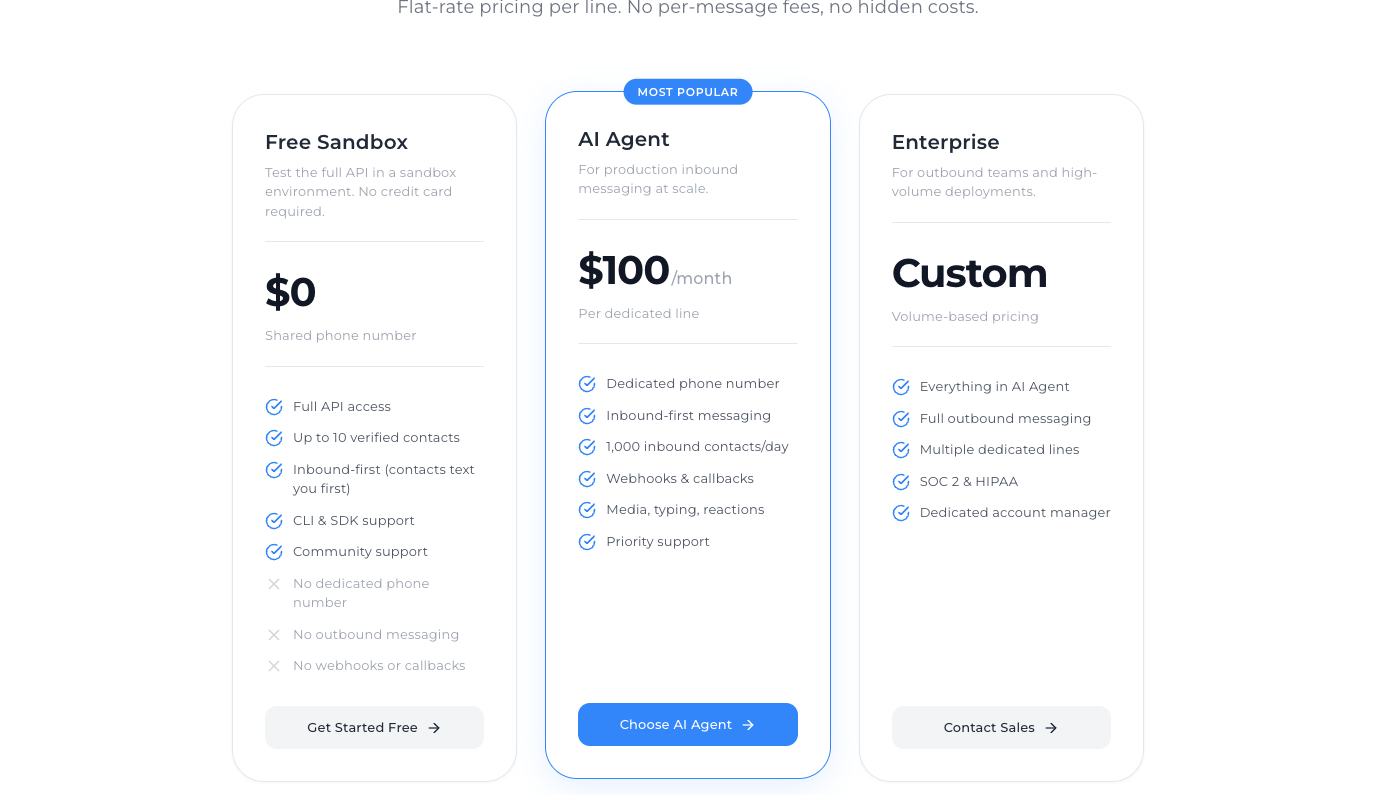
Source: sendblue.com/pricing, captured May 15, 2026.
The relevant phrases on Sendblue's own page, quoted verbatim:
- The plan is described as "For production inbound messaging at scale."
- The first feature listed under the $100 plan is "Inbound-first messaging."
- The volume metric is "1,000 inbound contacts/day" — note: inbound, not sending.
- The free tier above it explicitly lists "No follow-up messaging" as an exclusion.
- The Enterprise tier above it describes itself as "For sending teams and high-volume deployments," with "Full follow-up messaging" listed as a feature distinct from the AI Agent plan.
Plain English: if you sign up for the $100/month plan to text leads, you can't. The plan is built so that your customers text you first, then your AI agent or support team replies. That's a real product — it's how a customer-facing chatbot would work — but it's not what most teams are searching for when they search "iMessage API for sales."
For follow-up messaging on Sendblue, you need the Enterprise tier. Sendblue describes that tier on the same pricing page as "Custom — Volume-based pricing" with no published number. That's a sales-led pricing motion, which is fine if you're large enough to negotiate, but it makes "$100/month" a misleading anchor for buyers comparing prices in a spreadsheet.
What this means in a buying decision
If you're a B2B sales or marketing team comparing iMessage platforms, the $100/month Sendblue plan is not the plan you'd actually buy. It is built for a different use case (chatbot inbox). The real comparison is "Sendblue Enterprise quote" vs. competitor published prices — and Sendblue's Enterprise quote is not published, so the comparison can't be made on the marketing page.
Blooio $39/month: "Shared number" with a 5-contact/day cap
Blooio publishes its pricing at blooio.com/pricing. The lowest paid tier is $39/month. On the same page, here's how Blooio itself describes that tier:
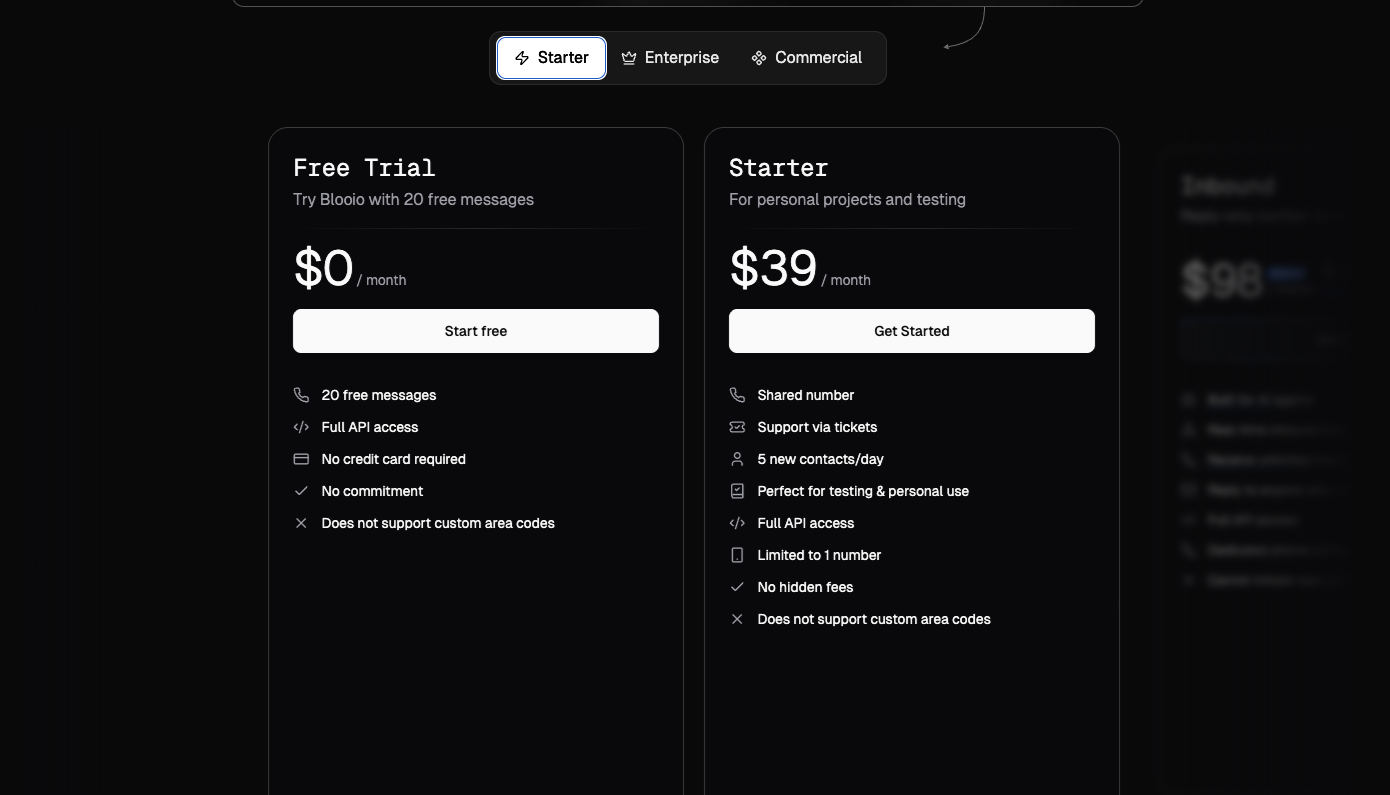
Source: blooio.com/pricing, captured May 15, 2026.
The relevant phrases on Blooio's own page, quoted verbatim:
- The first feature listed under the $39 plan is "Shared number."
- The volume metric is "5 new contacts/day."
- The line "Perfect for testing & personal use" appears in the tier description.
- A separate higher tier, "Commercial Dedicated," is listed at $289/month and describes itself as "Dedicated number (isolated to workspace)."
- The page notes that "Shared plans use managed shared pools" and "Dedicated plans use numbers isolated to your workspace."
Plain English: if you sign up for the $39/month plan, the phone number your messages send from is pooled across multiple Blooio customers — you don't own it. And you can only start 5 new conversations a day, so the maximum reach is roughly 150 new contacts per month. That makes the $39 tier viable for a hobby project or a sandbox, not for a B2B team running a real warm-follow-up program.
For a phone number that is yours alone, Blooio's published price is $289/month per line on the Commercial Dedicated tier. A discounted "Enterprise Dedicated" rate of $195/month per line is available but requires 6 or more lines (so a minimum spend of roughly $1,170/month).
What this means in a buying decision
The headline "$39/month" anchors the buying conversation, but it doesn't represent the product a B2B team would actually use in production. The comparable Blooio price for one dedicated number with no daily-contact cap is $289/month — about 7× the headline.
What sending on a dedicated line actually costs at each vendor
Here's the apples-to-apples comparison most buyers are actually trying to make: one dedicated phone number, follow-up messaging, enough daily volume to run a real campaign. Pricing as published on each vendor's own page on May 15, 2026:
| Vendor | Plan that matches the use case | Published price |
|---|---|---|
| Sendblue | Enterprise (the only tier with sending support) | Custom — not published |
| Blooio | Commercial Dedicated | $289 / month per line |
| Blooio | Enterprise Dedicated | $195 / month per line, 6+ lines required |
| Tuco AI | Starter | $149 / month per line, 200 messages/day, full API |
If "publishes their actual price" is a procurement requirement on your side, Sendblue's headline plan won't pass the screen.
How Tuco AI prices the same capability
For full transparency, here's Tuco AI's published pricing, straight from our own page:
- Mini — $59/month. Email-based iMessage line. Warm-follow-up sending from day 1. 50 new contacts/day. Email support.
- Starter — $149/month. Dedicated phone number. 50 new contacts/day, 200 total messages/day. Full API. Most popular.
- Growth — $299/month. 2 dedicated phone lines. 300 messages/day. AI auto-reply and AI SDR features.
- Enterprise — custom. For high-volume or multi-region.
There is no inbound-only plan, no shared-number tier, and no "talk to sales" wall to find the entry-level price. You can sign up at any tier without booking a call.
This isn't a claim that Tuco is cheaper across the board — Blooio's $39/month is genuinely cheaper than Tuco's $59/month if a shared sandbox with 5 contacts/day fits your use case. The point is: like-for-like, when you're comparing "one dedicated line, send-capable, real volume," Tuco's $149/month is roughly half of Blooio's $289/month, and Sendblue's number isn't even on the marketing page.
Why the headline-vs-real-price gap matters for B2B teams
Three reasons this isn't a small annoyance:
- Procurement and budgeting. When a marketing or RevOps lead pulls together a budget request, they price-shop from public pricing pages. A headline number that doesn't reflect the real plan inflates the "Sendblue is cheap" narrative and skews the decision.
- Trial-to-production handoff. If a developer trials the $100/month Sendblue plan in week one, builds an integration assuming sending works, and discovers in week three that sending requires Enterprise, that's two weeks of rework and a sales cycle they didn't plan for.
- Shared-number deliverability risk. On Blooio's $39 and $89 shared tiers, your messages route through a phone number that other customers also use. If one customer in that pool gets reported as spam, Apple's reputation signal applies to the number — i.e. to your messages too. A dedicated number isolates that risk to your own behavior.
Methodology and sourcing
- Screenshots: Captured directly from each vendor's own pricing page on May 15, 2026.
- Quotes: Every quoted phrase in this post is taken verbatim from the vendor's marketing page on that date. We have not edited or summarized the vendor's wording inside quotation marks.
- Sources: sendblue.com/pricing and blooio.com/pricing. Both pages may change at any time. If you find that the wording on either page has changed materially since publication, email us and we'll update.
- Conflict of interest: Tuco AI is a competitor to Sendblue and Blooio. We have a commercial interest in the outcome of this comparison. We've tried to mitigate that by quoting both vendors verbatim from their own pages and providing source links so readers can verify everything we say.
- Not legal advice or affiliation: Sendblue and Blooio are trademarks of their respective owners. This post is a comparative analysis of publicly published pricing pages. It does not allege fraud, dishonesty, or any unlawful conduct by either vendor — only that the headline price on each marketing page targets a use case different from the one most B2B buyers are searching for.
What to do next
If you're shopping for an iMessage API today:
- Pull the vendor's pricing page yourself and look for the words "inbound," "sending," "shared," and "dedicated." That's the cheapest filter.
- Decide which use case you actually need. Inbound-only (chatbot, support inbox) is a real product and Sendblue's $100 plan fits it. Most B2B sales use cases need send-capable lines, which is a different conversation.
- Compare like-for-like. Match "dedicated line + send-capable + the daily volume you'll actually use" across every vendor.
- If you want a published, all-in price for the dedicated/send-capable case, see tuco.ai/pricing. It's $149/month, on the page, no call required.
Frequently asked questions
Does Sendblue's $100/month plan let me send iMessages to leads?
No. Sendblue's own pricing page describes the $100/month 'AI Agent' tier as 'For production inbound messaging at scale' and 'Inbound-first messaging' — meaning customers must text you first. To send iMessage follow-ups (the standard B2B sales use case), Sendblue's published pricing page directs you to the 'Enterprise' tier with 'Custom — Volume-based pricing' and no public number. Source: sendblue.com/pricing, captured May 15, 2026.
Is Blooio's $39/month plan a dedicated phone number?
No. Blooio's own pricing page describes the $39/month 'Starter' tier as 'Shared number' with a hard cap of '5 new contacts/day' and labels it 'Perfect for testing & personal use'. Multiple Blooio customers share the same phone number on this tier. To get an exclusive phone number on Blooio, the 'Commercial Dedicated' tier is $289/month per line. Source: blooio.com/pricing, captured May 15, 2026.
What does 'inbound-only' mean for iMessage automation?
Inbound-only means the customer has to text you first; you can only reply. It is designed for chatbots, AI agents, and support inboxes where a user starts the conversation. It is not designed for sales outreach — you cannot use an inbound-only plan to message leads, send appointment reminders, or run a campaign to a contact list, because all of those require the platform to send the first message.
What does a 'shared phone number' mean on Blooio?
On Blooio's Starter ($39) and Commercial Shared ($89) tiers, the phone number you send from is pooled across multiple Blooio customers — you do not have exclusive use of it. The recipient sees a number that may also be used by unrelated businesses. Blooio's own page describes these tiers as 'Shared plans use managed shared pools'. To get an isolated number that only your workspace uses, Blooio's published price is $289/month for 'Commercial Dedicated' or $195/month for 'Enterprise Dedicated' with a 6+ line minimum.
What does Tuco AI charge for the same capability?
Tuco AI publishes its pricing: $59/month (Mini) for iMessage follow-up from day 1 on an email-based line; $149/month (Starter) for a dedicated phone number with 200 messages/day and full API access; $299/month (Growth) for 2 dedicated phone lines plus AI auto-reply. There is no inbound-only plan, no shared-number tier, no 'talk to sales' wall. See tuco.ai/pricing.
Where did the screenshots in this article come from?
Both screenshots were captured directly from Sendblue's and Blooio's own pricing pages on May 15, 2026. Each section in this article links back to the source URL so you can verify the wording yourself. Vendor pricing can change at any time; we will update this post if either page changes substantively.
About the author
Founder at Tuco AI. Spent 4 years building iMessage infrastructure for B2B sales teams. Writes about messaging, deliverability, and pricing transparency in the iMessage API category.


