Real-Time iMessage Events
Signed webhooks for every step of a conversation. See every delivery we made, replay any of them, and test every event before you go live.
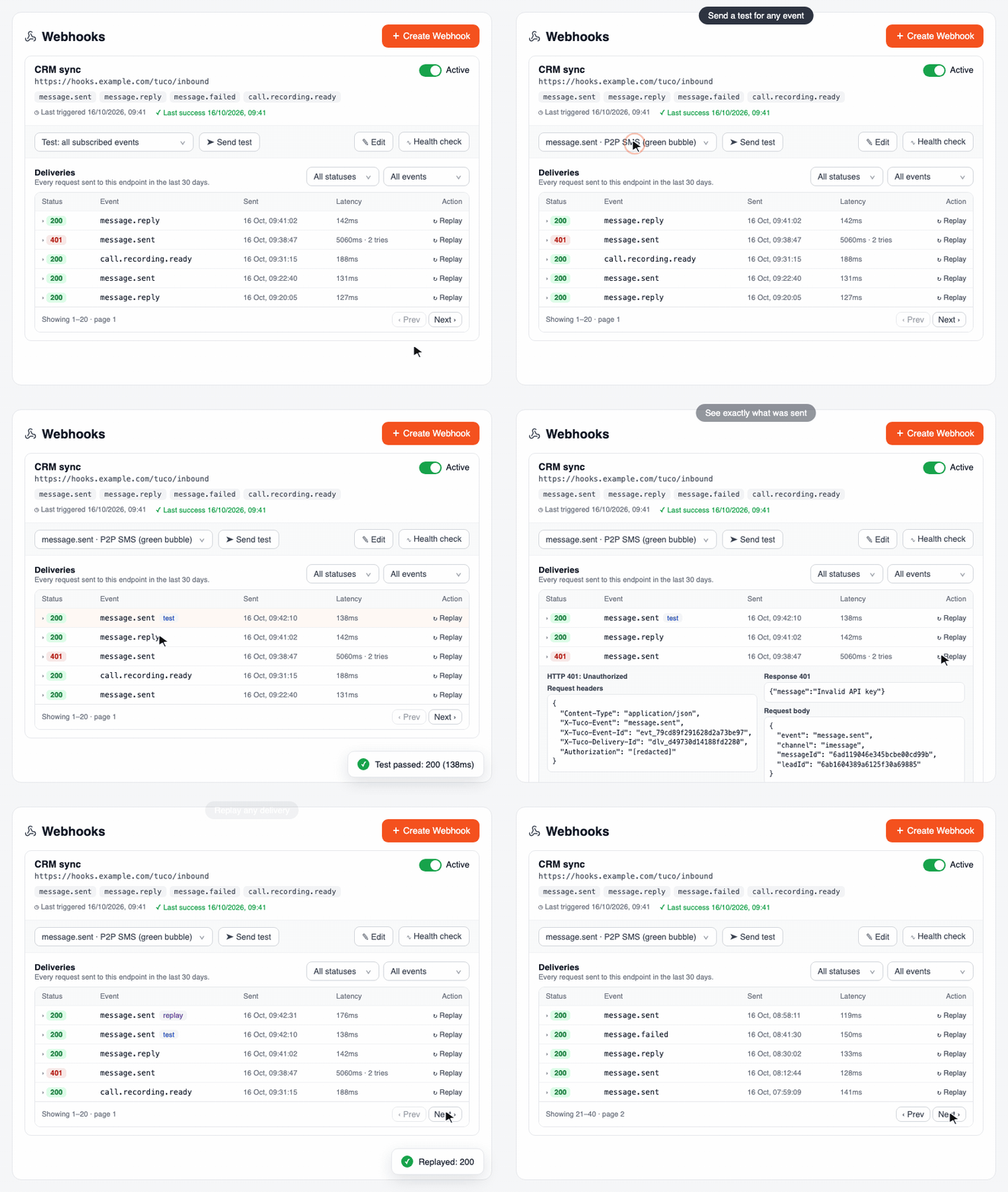
See, replay and test every delivery
Debug an integration without guessing what we sent.
Delivery log
Every request we sent to your endpoint in the last 30 days: status, latency, retries, the exact body and your endpoint's response.
One-click replay
Fixed your endpoint? Re-send any delivery. It goes to the webhook's current URL, signed with the current secret, marked X-Tuco-Replay.
Test any event
Send a realistic test for every event type and variant: text, photo, PDF, link, voice note, P2P SMS, failures and a heartbeat.
Exactly once
Each event fires once per webhook. Our single automatic retry reuses the same X-Tuco-Delivery-Id, so a slow endpoint can drop it.
Edit in place
Change the URL, events or Authorization header, pause with the Active switch, or rotate the signing secret.
All in the API
Deliveries, replay, test and secret rotation are public endpoints, so anything the dashboard does, your API key can do.
11 event types
Subscribe to the ones you need, per webhook.
message.sent
A message was sent. Fires once per message. The channel field says whether it went as iMessage or as SMS from your own line.
message.reply
The lead replied, including photos, files and voice notes.
message.failed
A message could not be sent after its retries, or expired before it could go out.
message.fallback
The recipient has no iMessage and the text went through your fallback SMS provider.
message.opened
Read receipt, when the recipient has them on.
message.reaction
The lead reacted (tapback) to a message you sent.
message.ai_draft
The AI copilot drafted a reply for review.
message.ai_draft_approved
A draft was approved and sent, from any channel.
message.ai_draft_rejected
A draft was rejected, from any channel.
conversation.handover
The AI agent handed the conversation to a person and stopped replying.
call.recording.ready
A call recording is stored, with a signed download link. Once per call.
Example payload
A message.sent body, shortened. Full payloads for every event →
{
  "event": "message.sent",
  "timestamp": "2026-03-12T22:57:03.000Z",
  "workspaceId": "org_3AZs4H8UsfFxVFONr6H4K75okaG",
  "messageId": "69b344bc6dae1d942ece4d0e",
  "channel": "imessage",
  "message": {
    "_id": "69b344bc6dae1d942ece4d0e",
    "message": "Here's your document.",
    "messageType": "imessage",
    "status": "sent",
    "fromLineId": "69ab427ac1feb77d7f46462e",
    "recipientPhone": "+919876543210",
    "recipientName": "Jane Doe",
    "leadId": "69b2c41d352a78479d2c623b",
    "sentAt": "2026-03-12T22:57:02.892Z"
  },
  "leadId": "69b2c41d352a78479d2c623b",
  "lead": { "firstName": "Jane", "phone": "+919876543210", "source": "gohighlevel" },
  "ghlContactId": "aMUQn0u0Z7cw0NQ7tJ5R",
  "ghlLocationId": "eL7DD22BdZ0rismu7qCA",
  "data": {}
}
Headers and signature
| X-Tuco-Signature | HMAC-SHA256 hex digest of the body, signed with your webhook secret |
| X-Tuco-Event | Event type, e.g. message.sent |
| X-Tuco-Event-Id | Stable id of the event. Same on a retry and on a replay |
| X-Tuco-Delivery-Id | Id of this delivery. Same on the automatic retry, new on a replay |
| X-Tuco-Replay | true when re-sent with Replay |
| X-Tuco-Test | true when sent as a test (the body also has testMode: true) |
const crypto = require('crypto');

// Verify against the raw body exactly as received.
app.post('/webhook', express.raw({ type: 'application/json' }), (req, res) => {
  const expected = crypto
    .createHmac('sha256', process.env.TUCO_WEBHOOK_SECRET)
    .update(req.body)
    .digest('hex');
  const signature = req.get('x-tuco-signature') || '';

  if (signature.length !== expected.length ||
      !crypto.timingSafeEqual(Buffer.from(signature), Buffer.from(expected))) {
    return res.status(401).send('Invalid signature');
  }

  const { event, messageId } = JSON.parse(req.body);
  res.status(200).send('OK'); // answer within 10 seconds
});Ready to Build with Webhooks?
Add an endpoint, send a test event, and watch it land in the delivery log.